How Long to Keep Bank Statements: What the IRS and CRA Say
How long to keep bank statements under IRS and CRA rules, for businesses and individuals: the usual periods, the cases that run longer, and whether a PDF or scan counts.
The Short Version
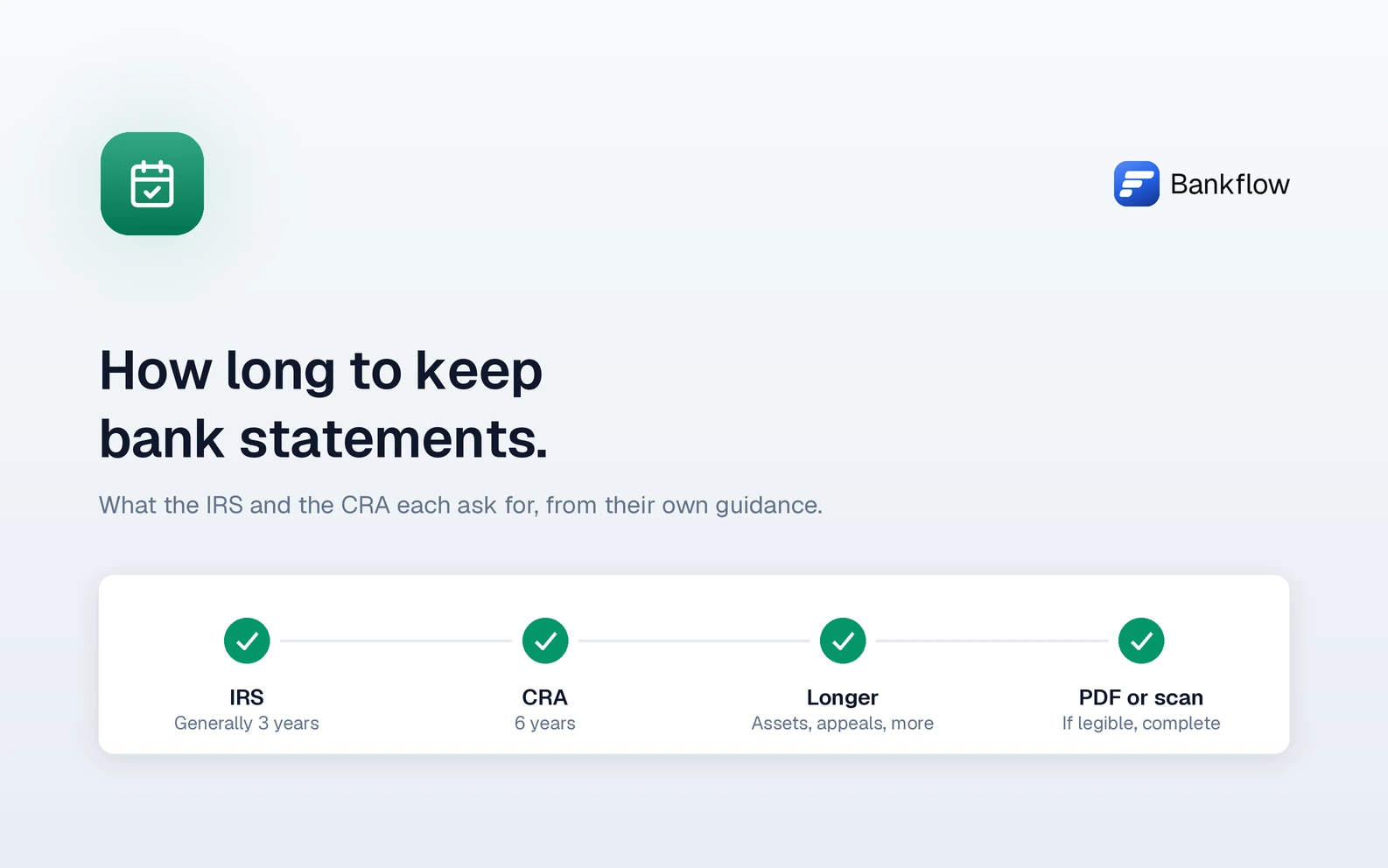
Neither the IRS nor the Canada Revenue Agency sets a period for bank statements as such. Both set a period for the records that support a tax return, and a bank statement is one of those records when it backs up income, an expense or a deduction. Under the general rules that comes to three years after the return is filed in the US, and six years from the end of the tax year the records relate to in Canada. Several cases run longer, and a few run indefinitely.
What follows is what each agency's own guidance says, linked under Sources and checked on November 17, 2026. It's a summary, not advice: which exception applies depends on the return, so check with the client's accountant for their situation.
At a Glance
| Country | Usual period | Longer when | Digital copies |
|---|---|---|---|
| United States (IRS) | 3 years after the return is filed | Income under-reported, a bad debt or worthless securities, employment tax records, property, no return or a fraudulent one | Accepted from an electronic storage system that meets Rev. Proc. 97-22 |
| Canada (CRA) | 6 years from the end of the last tax year the records relate to | A late return, an objection or appeal, long-term property | Electronic records kept in electronic form; scans accepted when the imaging meets the CGSB standard |
Is a Bank Statement a Record?
Yes, though rarely on its own. The CRA's page on what records are lists bank statements among the source documents a business keeps, beside deposit slips, cancelled cheques, invoices and receipts.
The IRS's Publication 583 says you may be able to prove payment with account statements prepared by financial institutions, provided they're "highly legible" and show:
- For a check: the check number, amount, payee's name, and the date the bank posted it.
- For an electronic transfer: the amount, the payee's name, and the date the bank posted it.
- For a credit card charge: the amount, the payee's name, and the transaction date.
The same publication adds that proof of payment "by itself, does not establish you are entitled to a tax deduction." A statement shows that money left the account and where it went; the invoice or receipt shows what it was for. That's why the statement and the documents behind it are kept together, for the same period. For those other documents, see how long to keep receipts.
United States: What the IRS Says
The IRS ties the period to the period of limitations: the time in which a return can be amended to claim a credit or refund, or the IRS can assess more tax. Publication 583 puts it as keeping records that support an item of income or deduction "until the period of limitations for that return runs out." The IRS page How long should I keep records? lists the periods:
- 3 years in the ordinary case.
- 3 years from filing, or 2 years from paying the tax if later, when you file a claim for a credit or refund after filing.
- 6 years if income that should have been reported wasn't, and it comes to more than 25% of the gross income shown on the return.
- 7 years for a claim for a loss from worthless securities or a bad debt deduction.
- Indefinitely if no return is filed, or a fraudulent one is.
- At least 4 years for employment tax records, after the date the tax becomes due or is paid, whichever is later. Publication 15 lists which records those are.
Publication 583 adds that, unless stated otherwise, the years run from when the return was filed, and that a return filed before its due date is treated as filed on the due date.
Property and Other Assets
Records relating to property are kept until the period of limitations expires for the year the property is disposed of, because they're needed to work out depreciation and the basis for any gain or loss. Publication 583 names canceled checks among the documents that support an asset's cost. Read with the rule above, the statement that shows what was paid for equipment bought years ago matters until the period runs out for the year that equipment is sold.
Personal Statements
The IRS's Topic 305 applies the same principle to individuals: keep records "as long as they may become material" to the tax law, which "generally will be until the period of limitations expires for that return," and keep records relating to property, such as a home, until the period expires for the year it's sold. A personal statement that supports nothing on a return isn't covered by these rules at all. The IRS also notes that an insurance company or creditors may ask for records to be kept longer than it does, so other reasons can apply.
Canada: What the CRA Says
The CRA's page on where to keep records and for how long sets the general rule: keep all required records and supporting documents "for a period of six years from the end of the last tax year they relate to." Its exceptions:
- A late return: six years from the date that return is filed.
- An objection or appeal: until the latest of the date it's resolved, the date for filing any further appeal has passed, or the end of the six-year period.
- Long-term property: records about long-term acquisitions and disposals of property, the share registry, and other history that would affect a sale, liquidation or wind-up of the business are kept indefinitely.
- A dissolved corporation: two years after the date of dissolution.
- A non-incorporated business that ends: six years from the end of the tax year in which it ended.
Records can be destroyed before the period is up only with the CRA's written permission, asked for on Form T137 or in writing to the tax services office.
Where they're kept. The same page says records are kept at the place of business or residence in Canada, unless the CRA gives written permission to keep them elsewhere, and that records kept outside Canada and accessed electronically from Canada "are not considered to be records kept in Canada." Worth knowing before choosing where a client's statements are stored.
Individuals. The CRA's income tax guide for individuals says to keep supporting documents for 6 years in case the CRA asks to see them, whether the return was filed on paper or electronically, along with a copy of the return and the notice of assessment or reassessment.
Paper, PDF or Scan?
United States
Publication 583 says the requirements for paper records apply equally to an electronic storage system, meaning one that keeps records by scanning them or by moving them onto electronic media. The original paper may be destroyed once the system has been tested to show it reproduces the records as the IRS requires, and the IRS may test the system itself. The detail is in Revenue Procedure 97-22, which asks that stored records show "a high degree of legibility and readability" on screen and on paper, and lists keeping the paper copy of any record that is illegible, or can't be accurately or completely transferred, among the controls a system should have.
Canada
The CRA's page on acceptable formats says records created electronically are kept "in an electronic readable format, even if you have paper printouts." A statement downloaded from online banking is created electronically, so on that wording the PDF itself is what's kept, not only a printout.
Paper can be scanned, provided the imaging follows the national standard, CAN/CGSB-72.34, Electronic Records as Documentary Evidence. The image then becomes the permanent record and the paper can be destroyed; a business that can't meet the standard keeps the originals. The image has to be an accurate reproduction that gives the same information as the paper, with no significant detail obscured by its resolution, tone or colour. The CRA also asks for backups of records kept on rewritable media.
What the Two Have in Common
- Complete: every page of the statement, including the summary page with the balances, not only the pages with transactions.
- Legible: a scan or photo where every figure can be read without guessing.
- As issued: the PDF the bank produced, not a copy that's been edited.
- The statement, not a summary of it: a spreadsheet of the rows is useful, but it's a reading of the statement, not the record. Checking that reading is covered in how to tell if a bank statement converter got it right.
A Routine for Keeping Clients' Statements
For a bookkeeper holding statements for several clients, the rules above come down to having the complete set, for every account, when someone asks for it. Four habits get you there.
- Download every month. Get each statement as a PDF soon after it closes. How far back online banking reaches varies from bank to bank, and an account the client closes is harder to get statements from later. When a client sends them, a standing request works better than a chase; see getting bank statements from clients.
- Keep them in one place per client. One folder per client, one per account inside it, and the same naming every time: bank, the last digits of the account, and the period, such as Harbour Street ··7731 2026-09.pdf. The last digits keep two cards at one bank apart.
- Check that the set is complete. Every month is there for every account, and each statement's opening balance matches the previous one's closing balance. A balance that doesn't carry over means a statement is missing in between, or one is from another account. Checking every month before year-end walks through it, and does your bank statement add up? covers the checks within a single statement.
- Back the set up, and don't delete on a date alone. Keep a second copy outside the place you work in. Before a year's statements are thrown away, check with the client's accountant: an asset still owned, a late return or an open appeal keeps the period running.
If a client arrives with months or years missing, catch-up bookkeeping from old statements covers getting them and bringing them into the books in order.
Where Bankflow Fits
Bankflow helps with the checking half of the routine:
- Collecting: a client uploads statements through one link, without an account. See client uploads.
- Gaps and breaks: the Statements page marks a statement Gap when more than two weeks are missing since the previous one, Mismatch when its opening balance doesn't meet the previous closing balance, and Duplicate when it repeats one already imported. See reviewing a statement.
- The year at a glance: Workpapers lays out every account by every month, counts the months covered against the months expected, and lets you request the missing ones from the client.
It isn't meant to be the client's records archive. The rows it reads are a reading of the statement, and an original PDF can be deleted from Bankflow, by you or automatically when Delete original document after processing is on. Keep the PDFs themselves in the client's own storage for as long as the rules above call for.
Sources
Each checked on November 17, 2026.
- IRS, How long should I keep records?
- IRS, Publication 583, Starting a Business and Keeping Records
- IRS, Topic no. 305, Recordkeeping
- IRS, Revenue Procedure 97-22 (electronic storage systems)
- IRS, Publication 15, Employer's Tax Guide
- Canada Revenue Agency, Where to keep your records, for how long, and how to request the permission to destroy them early
- Canada Revenue Agency, What are records, who has to keep them, and why it is important
- Canada Revenue Agency, Acceptable format, imaging paper documents, and backing up electronic files
- Canada Revenue Agency, Federal income tax and benefit information for 2025 (supporting documents)
Continue reading

Your First Month-End Close for a New Client, Step by Step
Seven steps from asking for the month's files to sending the client their report, and what to set up in month one so month two is faster.

How to Start a Bookkeeping Business in 2026: The First 90 Days
No license is needed for bookkeeping, but some titles are restricted. Certifications, insurance, pricing, tools and a 90-day plan, following one new practice.
How to Tell If a Bank Statement Converter Got It Right
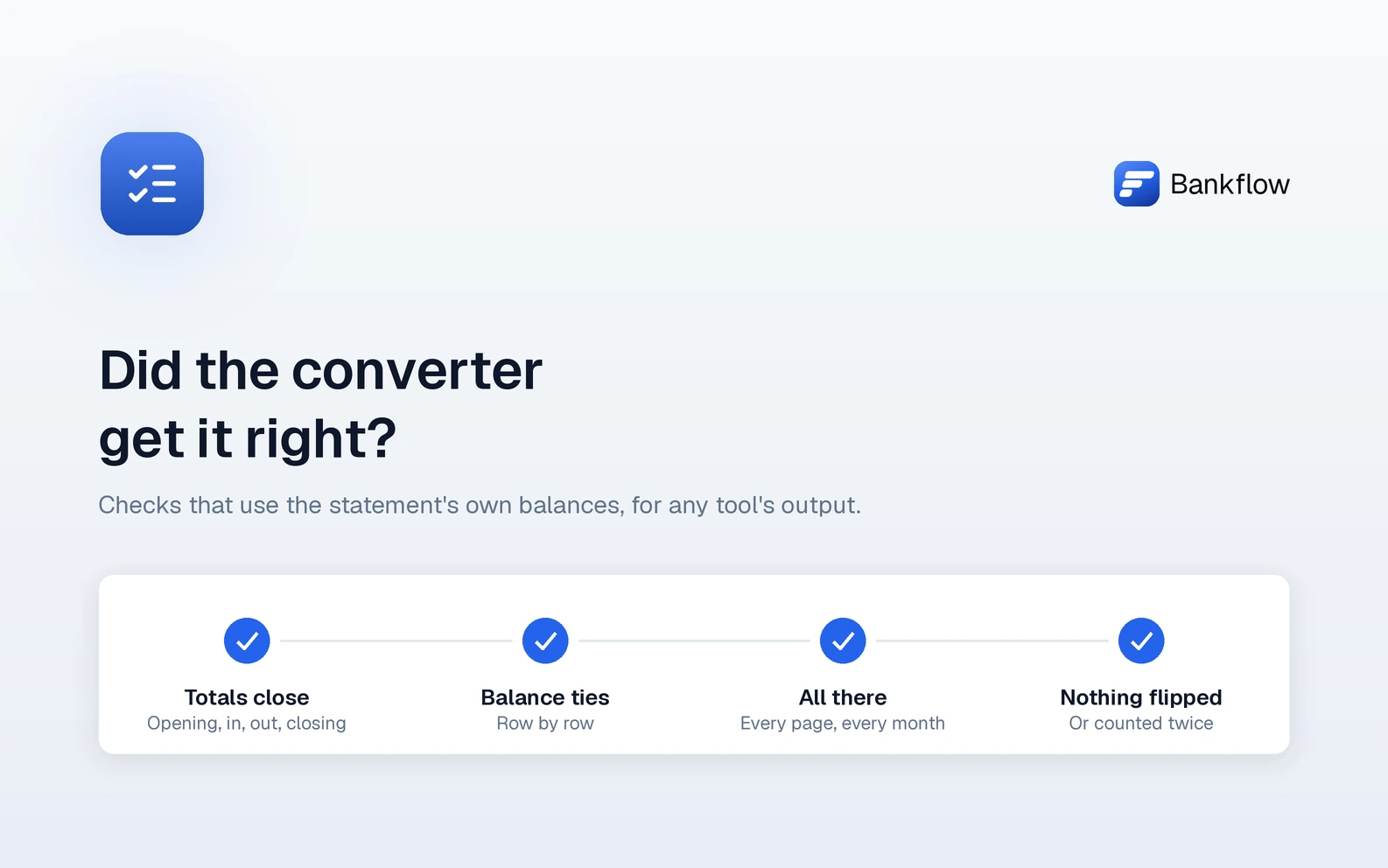
Eight checks for the output of any bank statement extraction or analysis software: the balances, the running balance, pages, duplicates, signs, dates and scans.
Turn your next statement into usable data.
Review the extracted transactions before export. No bank connection or credit card required.
Analyze a statement free